


It's hard to imagine keeping secrets about an aircraft so spectacularly huge that the Guinness Book of Records is believed to be just days away from rubber-stamping its entry.
But
until the vast new Airlander 10 airship was unveiled fully assembled in
a giant hangar north of London on March 21, it still had a few to
reveal.
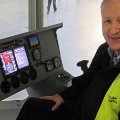
"Last time I flew this in
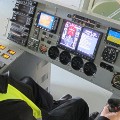
2012," says test pilot David Burns, gesturing at the cockpit controls of
the aircraft he'll soon take to the skies in its latest incarnation,
"no one was allowed to take photographs of this."
The
controls are not entirely different from those of an ordinary plane but
include extra switches and gauges that govern gigantic balloons pumped
full of helium.
Back in 2012, they
were secret thanks to the aircraft's previous life as a U.S. military
project that was grounded due to defense cuts.
After further development, it's now literally back afloat.
Ready for action
20 photos: The world's 'biggest' aircraft readies for takeoff
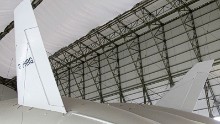
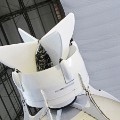
Tailfins – Much like a conventional aircraft, the Airlander is steered using tailfins.
Hide Caption
11 of 20
20 photos: The world's 'biggest' aircraft readies for takeoff
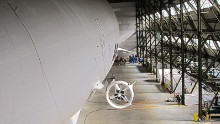
Safety measures – Designed
originally for military surveillance, the Airlander's engines operate
independently to increase safety. If all four failed, it could still
drift to a safe landing.
Hide Caption
12 of 20
20 photos: The world's 'biggest' aircraft readies for takeoff
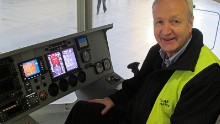
Chief test pilot – Chief test pilot David Burns flew an earlier incarnation of the Airlander in tests over U.S. airspace in 2012.
Hide Caption
13 of 20
20 photos: The world's 'biggest' aircraft readies for takeoff
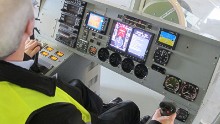
Aircraft-style controls – Burns,
a veteran test pilot who has also worked as a commercial aviator, says
the controls are similar to those of a plane. He says most pilots would
adapt easily to flying the Airlander.
Hide Caption
14 of 20
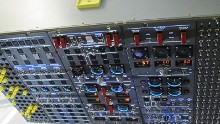
20 photos: The world's 'biggest' aircraft readies for takeoff
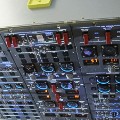
Overhead panel – The Airlander's aircraft control panel also includes switches and gauges to control the helium.
Hide Caption
15 of 20
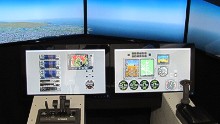
20 photos: The world's 'biggest' aircraft readies for takeoff
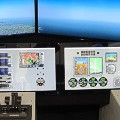
Simulator – An
Airlander simulator has been built inside the hangar. Burns and his
team have been familiarizing themselves with the controls before flying
the real thing.
Hide Caption
16 of 20
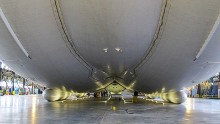
20 photos: The world's 'biggest' aircraft readies for takeoff
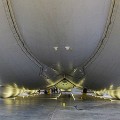
Payload – A
view of the rear of the aircraft reveals the space where up to 10 tons
of cargo could be stowed. Airlander's creators are hoping to develop a
newer ship capable of carrying 50 tonnes.
Hide Caption
17 of 20
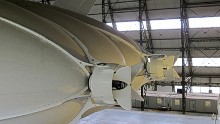
20 photos: The world's 'biggest' aircraft readies for takeoff
Greener skies? – Airlander
10's engines burn less fuel and make less noise than standard aircraft.
It can carry enough fuel to keep it airborne for five days.
Hide Caption
18 of 20

20 photos: The world's 'biggest' aircraft readies for takeoff
Flying into the future – HAV's
program director Nick Allman says the Airlander has the potential to
change aviation forever. "We see it as the future," he told CNN.
Hide Caption
19 of 20
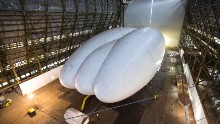
20 photos: The world's 'biggest' aircraft readies for takeoff
First flights – If tests prove successful, the Airlander could be making its first proper UK flights later in 2016.
Hide Caption
20 of 20
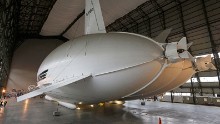
20 photos: The world's 'biggest' aircraft readies for takeoff
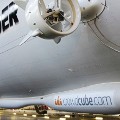
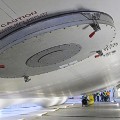
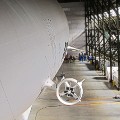
Airlander 10 – The Airlander 10 is said to be the world's biggest aircraft -- more than 20 meters longer than the Airbus A380 superjumbo.
Hide Caption
1 of 20
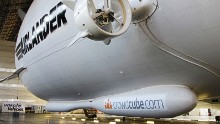
20 photos: The world's 'biggest' aircraft readies for takeoff
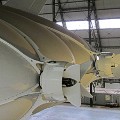
Diesel V8 engines – Four diesel V8 engines will propel the Airlander 10 to speeds of up to 91 miles an hour.
Hide Caption
2 of 20
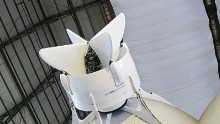
20 photos: The world's 'biggest' aircraft readies for takeoff
Vertical takeoff – Engine fins can be altered to give vectored thrust, allowing the Airlander to carry out vertical takeoffs and landings.
Hide Caption
3 of 20
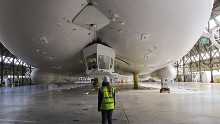
20 photos: The world's 'biggest' aircraft readies for takeoff
Final assembly – The current Airlander design was unveiled to the public, fully assembled, for the first time on March 21.
Hide Caption
4 of 20
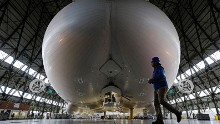
20 photos: The world's 'biggest' aircraft readies for takeoff
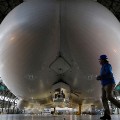
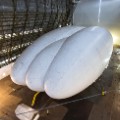
Posterior – Unkind observers have nicknamed Airlander the "flying bum," claiming it looks like a human posterior.
Hide Caption
5 of 20
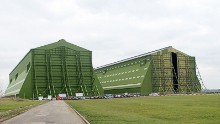
20 photos: The world's 'biggest' aircraft readies for takeoff
Cardington Airbase – Airlander
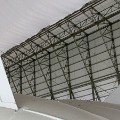
10 is housed in one of the largest air hangars in the world. The
building was once home to the doomed R101, a massive hydrogen-filled
airship that crashed in 1930.
Hide Caption
6 of 20
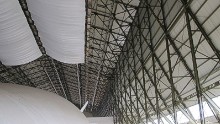
20 photos: The world's 'biggest' aircraft readies for takeoff
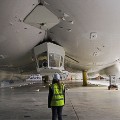
Restoration project – The
old hangar is a protected building under English planning laws and was
carefully restored to accommodate the Airlander. Those overhead drapes
are to catch droppings from birds entering the building.
Hide Caption
7 of 20
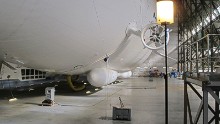
20 photos: The world's 'biggest' aircraft readies for takeoff
Lift off – Pumped
full of helium, Airlander 10 demonstrates its buoyancy within the
hangar. It faces several weeks of ground tests before it'll be allowed
out to fly.
Hide Caption
8 of 20
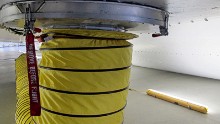
20 photos: The world's 'biggest' aircraft readies for takeoff
Air bags – As
well as helium, Airlander contains air chambers that can be filled or
emptied to help maintain the aircraft's shape as the helium changes
volume at different altitudes.
Hide Caption
9 of 20
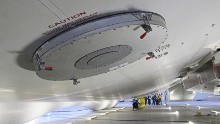
20 photos: The world's 'biggest' aircraft readies for takeoff
Ballonets – The
air pockets, or ballonets, are accessible via hatches in the hull. The
helium chambers are not designed for access and would require special
breathing equipment to access.
Hide Caption
10 of 20
20 photos: The world's 'biggest' aircraft readies for takeoff
Tailfins – Much like a conventional aircraft, the Airlander is steered using tailfins.
Hide Caption
11 of 20
20 photos: The world's 'biggest' aircraft readies for takeoff
Safety measures – Designed
originally for military surveillance, the Airlander's engines operate
independently to increase safety. If all four failed, it could still
drift to a safe landing.
Hide Caption
12 of 20
20 photos: The world's 'biggest' aircraft readies for takeoff
Chief test pilot – Chief test pilot David Burns flew an earlier incarnation of the Airlander in tests over U.S. airspace in 2012.
Hide Caption
13 of 20
20 photos: The world's 'biggest' aircraft readies for takeoff
Aircraft-style controls – Burns,
a veteran test pilot who has also worked as a commercial aviator, says
the controls are similar to those of a plane. He says most pilots would
adapt easily to flying the Airlander.
Hide Caption
14 of 20
20 photos: The world's 'biggest' aircraft readies for takeoff
Overhead panel – The Airlander's aircraft control panel also includes switches and gauges to control the helium.
Hide Caption
15 of 20
20 photos: The world's 'biggest' aircraft readies for takeoff
Simulator – An
Airlander simulator has been built inside the hangar. Burns and his
team have been familiarizing themselves with the controls before flying
the real thing.
Hide Caption
16 of 20
20 photos: The world's 'biggest' aircraft readies for takeoff
Payload – A
view of the rear of the aircraft reveals the space where up to 10 tons
of cargo could be stowed. Airlander's creators are hoping to develop a
newer ship capable of carrying 50 tonnes.
Hide Caption
17 of 20
20 photos: The world's 'biggest' aircraft readies for takeoff
Greener skies? – Airlander
10's engines burn less fuel and make less noise than standard aircraft.
It can carry enough fuel to keep it airborne for five days.
Hide Caption
18 of 20
20 photos: The world's 'biggest' aircraft readies for takeoff
Flying into the future – HAV's
program director Nick Allman says the Airlander has the potential to
change aviation forever. "We see it as the future," he told CNN.
Hide Caption
19 of 20
20 photos: The world's 'biggest' aircraft readies for takeoff
First flights – If tests prove successful, the Airlander could be making its first proper UK flights later in 2016.
Hide Caption
20 of 20
20 photos: The world's 'biggest' aircraft readies for takeoff
Airlander 10 – The Airlander 10 is said to be the world's biggest aircraft -- more than 20 meters longer than the Airbus A380 superjumbo.
Hide Caption
1 of 20
20 photos: The world's 'biggest' aircraft readies for takeoff
Diesel V8 engines – Four diesel V8 engines will propel the Airlander 10 to speeds of up to 91 miles an hour.
Hide Caption
2 of 20
20 photos: The world's 'biggest' aircraft readies for takeoff
Vertical takeoff – Engine fins can be altered to give vectored thrust, allowing the Airlander to carry out vertical takeoffs and landings.
Hide Caption
3 of 20
20 photos: The world's 'biggest' aircraft readies for takeoff
Final assembly – The current Airlander design was unveiled to the public, fully assembled, for the first time on March 21.
Hide Caption
4 of 20
20 photos: The world's 'biggest' aircraft readies for takeoff
Posterior – Unkind observers have nicknamed Airlander the "flying bum," claiming it looks like a human posterior.
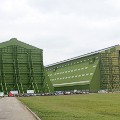
Hide Caption
5 of 20
20 photos: The world's 'biggest' aircraft readies for takeoff
Cardington Airbase – Airlander
10 is housed in one of the largest air hangars in the world. The
building was once home to the doomed R101, a massive hydrogen-filled
airship that crashed in 1930.
Hide Caption
6 of 20
20 photos: The world's 'biggest' aircraft readies for takeoff
Restoration project – The
old hangar is a protected building under English planning laws and was
carefully restored to accommodate the Airlander. Those overhead drapes
are to catch droppings from birds entering the building.
Hide Caption
7 of 20
20 photos: The world's 'biggest' aircraft readies for takeoff
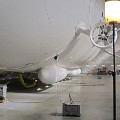
Lift off – Pumped
full of helium, Airlander 10 demonstrates its buoyancy within the
hangar. It faces several weeks of ground tests before it'll be allowed
out to fly.
Hide Caption
8 of 20
20 photos: The world's 'biggest' aircraft readies for takeoff
Air bags – As
well as helium, Airlander contains air chambers that can be filled or
emptied to help maintain the aircraft's shape as the helium changes
volume at different altitudes.
Hide Caption
9 of 20
20 photos: The world's 'biggest' aircraft readies for takeoff
Ballonets – The
air pockets, or ballonets, are accessible via hatches in the hull. The
helium chambers are not designed for access and would require special
breathing equipment to access.
Hide Caption
10 of 20
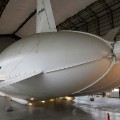

So
much so that, at its grand unveiling, Airlander could be seen straining
at its moorings and drifting, ever so slightly, a few meters off the
ground, apparently ready for action.
Soon,
after extensive ground testing, it'll be leaving its hangar to begin
the 200 hours of test flights it needs to complete before being offered
to prospective customers.
It may
still have a military role -- the UK government thinks so and has
stumped up cash alongside $3 million of crowdsourced funds -- but Hybrid
Air Vehicles, which revived the project, envisages plenty of civilian
uses.
Nick Allman, HAV's program director, says it has the potential to change aviation forever.
"We
see it as the future," he told CNN. "It's going to be cheaper, it's
going to be greener, we're going to be able to go to places we can't go
to and from now.
"It's going to be a whole revolution in how we use air transport."
Part airship, part helicopter, part plane, the 92-meter-long Airlander 10 owes its buoyancy to 38,000 cubic meters of helium.
The
pressure of the lighter-than-air gas helps maintain the aerodynamic
shape of a hull made from carbon fiber, Kevlar and Mylar.
Unfortunate shape

The Airlander 10's control panel features extra switches to control the helium.
That
shape -- unkindly described by some as a "flying bum" because it
resembles a rather large posterior -- provides 40% of Airlander's lift
as it flies through the air.
It's
also fitted with four 325 horsepower V8 diesel engines that can propel
it to speeds of up to 148 kilometers per hour (91 mph) and provide
vertical thrust for horizontal takeoffs.
Beneath
it is space for a payload capable of carrying up to 10 tonnes and a set
of retractable pneumatic "skids" that can be used for landing on land,
sand, water or ice.
Its
environmental credentials come from its greatly reduced fuel consumption
and engine noise levels, in comparison to jet planes.
It
can reach heights of up to 6,100 meters (16,000 feet) and stay aloft
for five days, making it ideal, say its creators, for surveillance,
cargo drops or even leisure excursions.
Airlander
hangs on to its helium, which is divided into several compartments.
These can be manipulated to help control the aircraft but also provide
fail-safes in case one is breached.
Altitude
is altered by inflating or deflating auxiliary air bags known as
"ballonets," and by altering its speed -- without forward momentum it
gently glides to the ground.
'Special machine'

Airlander's creators say it could carry people for safaris in its windowed lounge.
"It's
really quite a special machine to fly," says test pilot Burns. "The
view from the flight deck is excellent because of the large windows and
the airship characteristics, flying at a fairly lowish altitude."
He
also stresses the vehicle's safety -- an issue the airship industry is
fated to address thanks to the enduring memories of incidents such as
the 1937 disaster in which 36 people were killed when the German
Hindenburg airship exploded in New Jersey.
Airlander's
current home, one of two cathedral-like hangars that tower over flat
countryside around Cardington Airfield, is another reminder.
The
structures originally housed the R101, a British-built airship (more
than double the size of Airlander) that crashed in October 1930, killing
48 people.
With inert gas helium replacing the flammable hydrogen once used in airships, explosion and fire is no longer a danger.
Burns says other risks have also been designed out.
"The
aircraft is very resistant to many failures," he adds. "It has four
engines, all totally independent, because it was built as and designed
originally as a military aircraft."
Once
Airlander has proved its safety credentials to the relevant aviation
authorities, it'll begin flights aimed at attracting commercial clients.
Currently, the aircraft is fitted
with a viewing deck that will be used to transport potential customers
-- and potentially investors including Iron Maiden singer Bruce
Dickinson, who has reportedly put $360,000 into the venture.
If
Airlander 10 proves successful, blueprints have already been drawn up
for Airlander 50, a bigger, better version capable of lifting five times
the cargo.
That could truly signal the rebirth of airships

0 comments:
Post a Comment